April 6, 2026
CTE Career Exploration: Expanding AR/VR at Mayfair High
Director of CTE
Discover how Mayfair High School uses zSpace AR/VR laptops to transform CTE career exploration in healthcare, biology, and construction.
In the rapidly evolving landscape of Career Technical Education (CTE), the challenge for modern high schools is no longer just providing technology, but making that technology meaningful and accessible across the entire campus. Bellflower Unified School District is meeting this challenge head-on. At Mayfair High School in Lakewood, California, a new model for CTE career exploration is taking shape—one that leverages immersive augmented and virtual reality (AR/VR) to bridge the gap between traditional classroom learning and real-world industry applications.
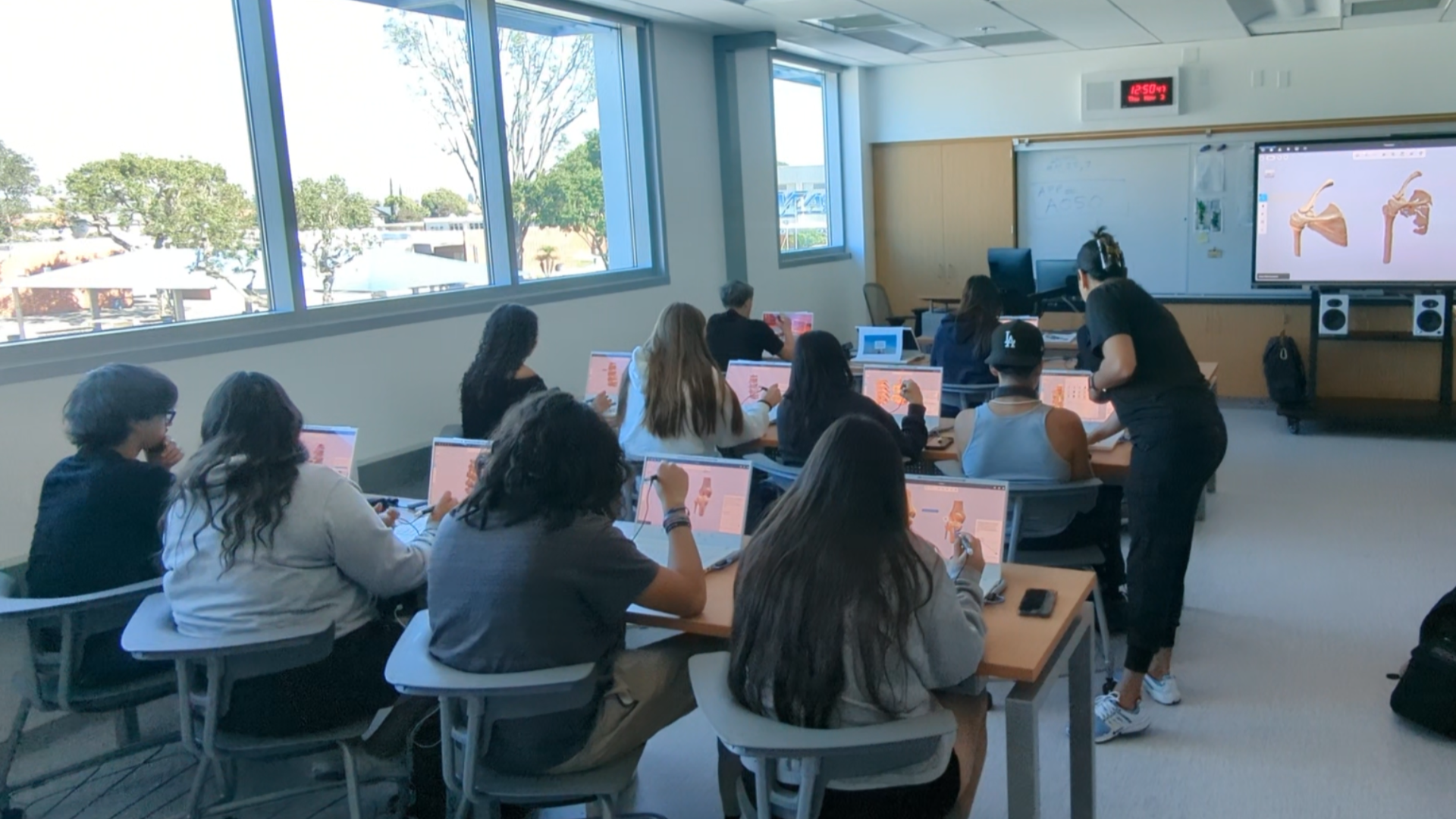
By establishing a dedicated 36-station zSpace Inspire AR/VR laptop lab, Mayfair High School has created a centralized hub for innovation. Managed by CTE Technology Technician Javier Beanes, this lab isn’t just a room for specialized computer science students; it is a campus-wide resource where biology, health science, and construction students can interact with complex systems in three dimensions. This shift toward a shared innovation space is proving that when immersive technology is implemented strategically, it can transform student engagement across every department and prepare them for high-demand careers.
As schools nationwide look for ways to satisfy board expectations, increase student achievement, and improve district reputation, the Mayfair model provides a clear roadmap. Through headset-free AR/VR laptop solutions, students are gaining hands-on exposure to high-demand fields like healthcare and biological sciences without the logistical hurdles of expensive physical labs or specialized equipment. This comprehensive approach ensures that every student—regardless of their primary subject area—has the opportunity to develop the spatial reasoning and technical skills required for the 21st-century workforce.
The Power of a Centralized Innovation Hub in K-12
One of the most significant barriers to implementing AR/VR in education is the "silo effect," where expensive technology remains locked in a single classroom or reserved for a specific "tech-heavy" program. Mayfair High School has dismantled this barrier by positioning its 36-station zSpace Inspire lab as a shared innovation hub. This centralized approach allows teachers from multiple departments to schedule time in the lab, ensuring that the investment in CTE career exploration technology reaches the widest possible student demographic.
The "Innovation Hub" model is particularly effective because it treats immersive technology as a foundational tool rather than a niche accessory. In this environment, the zSpace Inspire laptops serve as a bridge between abstract theory and practical application. Because the zSpace platform is headset-free, students can look at a 3D heart, a mechanical engine, or a complex molecular structure together. This social aspect of learning is critical in a high school setting, where collaboration and communication are key components of career readiness and soft-skill development.
“Our goal is to make technology meaningful for students and teachers,” says Javier Beanes, CTE Technology Technician at Mayfair High School. “The zSpace lab gives students opportunities to explore careers and complex concepts in ways that traditional classrooms can’t always provide. They can visualize anatomy or investigate biology by interacting directly with the content using a stylus.”
Expanding CTE Pathways: Healthcare, Biology, and Construction
The impact of the zSpace lab is most visible in Mayfair’s specific CTE pathways. By providing students with the ability to interact with real-world systems in a risk-free virtual environment, the school is accelerating the learning curve for complex subjects. In the healthcare and biological sciences programs, the ability to visualize and manipulate human anatomy is a game-changer for student engagement and retention.
Advanced Healthcare and Anatomy Visualization
In health science lessons, students can examine human anatomy and physiological systems through interactive 3D models. This immersive environment allows them to practice the spatial reasoning required for medical careers—skills that are often difficult to develop through 2D textbooks alone. Using the zSpace stylus, students can "pull" a virtual bone from a skeleton, rotate it, and examine its structure from every angle. This hands-on approach helps students build both academic understanding and awareness of high-demand healthcare careers, such as nursing, surgery, and physical therapy.
Biology and Life Sciences Exploration
For biology students, the lab serves as a virtual laboratory where they can investigate cellular structures and biological processes. These simulations make abstract or microscopic concepts tangible. By interacting with molecular structures in a 3D space, students can better grasp the mechanics of life, leading to improved test results and a higher interest in STEM-related fields. The ability to "zoom in" on a cell or watch a chemical reaction occur in 3D provides a level of clarity that transforms the science classroom into a dynamic exploration site.
Construction and Engineering Principles
Beyond the sciences, the lab supports construction-focused activities and engineering principles. Students can explore structural systems, visualizing how different components of a building come together to support a load. This early exposure to technical skills and engineering principles prepares students for careers in the building trades and architecture. It provides a safe environment to experiment with design and structural integrity, allowing students to learn through trial and error without the waste of physical materials or the risks associated with heavy machinery.
Technician Leadership: A Catalyst for School-Wide Innovation
A unique and vital component of the Mayfair High School model is the role of the site CTE technology technician as an innovation leader. Javier Beanes does more than maintain hardware; he serves as a collaborator and strategist for teachers across the campus. This "Technician Leadership" model is a powerful strategy for schools looking to scale emerging technologies effectively.
Beanes works directly with educators to identify new ways to integrate AR, VR, and AI tools into their existing curriculum. By helping teachers navigate the technology and identifying the best applications for specific lesson plans, he reduces the "barrier to entry" for staff who may be unfamiliar with immersive platforms. This support system ensures that the zSpace Inspire lab remains a high-usage, high-impact space rather than a forgotten asset. When a teacher knows they have technical and pedagogical support, they are far more likely to embrace innovative tools that enhance student learning.
His work demonstrates that the success of educational technology depends as much on human leadership and support as it does on the hardware itself. By repurposing the lab into a shared space and providing dedicated support, Beanes has enabled Mayfair High School to scale innovative learning experiences far beyond a single classroom, creating a culture of continuous technological exploration and career readiness.
Connecting Classroom Learning to Future Careers
The ultimate goal of CTE career exploration is to help students envision themselves in professional roles. Immersive technology plays a crucial role in this process by demystifying complex industries. When a student can virtually "step inside" a car engine or perform a virtual dissection, the career becomes more than just a title—it becomes a tangible possibility.
At Mayfair, the immersive platform helps students connect classroom learning to future career possibilities by providing a "low-stakes, high-engagement" environment. Students can explore high-demand fields without the pressure of failing in a physical lab. This builds the confidence and curiosity needed for future success in post-secondary education and the workforce. By giving students the ability to interact with real-world systems, educators are preparing them for the technological advancements they will inevitably encounter in their careers.
Conclusion: The Future of CTE is Immersive
As school districts nationwide expand their CTE career exploration programs, the need for cost-effective, scalable, and engaging technology has never been higher. Immersive learning platforms like zSpace allow students to gain early exposure to real-world skills and industries that were previously difficult to access in a classroom setting. By removing the need for headsets, zSpace makes AR/VR a collaborative, classroom-friendly experience that supports both academic achievement and career readiness.
“Schools like Mayfair High School show how immersive technology can connect classroom learning to career discovery,” says Paul Kellenberger, CEO of zSpace. “By giving students the ability to interact with real-world systems and career scenarios, educators are helping them build the confidence and curiosity needed for future success.”
The Mayfair High School model proves that with the right technology, the right leadership, and a commitment to campus-wide access, schools can provide every student with the tools they need to succeed in the high-demand careers of tomorrow. Whether it is through virtual healthcare simulations, structural engineering models, or interactive biology labs, the future of education is here—and it is immersive.
To learn more about how zSpace can help your district expand career exploration and CTE pathways, contact us today for a demonstration or explore our zSpace Inspire solutions. Together, we can prepare the next generation of innovators, problem-solvers, and leaders.