April 15, 2026
Do AR/VR Tools Improve Student Outcomes? The Research
Director of Customer Success - Northeast
Research from Stanford, Texas Tech, and the NSF shows AR/VR learning boosts engagement, comprehension, and test performance. See the evidence.
When district leaders evaluate a new classroom technology, one question rises above the rest: will it actually improve AR VR student outcomes, or will it become another underused device gathering dust on a cart? It is a fair question, and it is one zSpace welcomes. Educators and administrators should demand evidence before committing instructional time, professional development, and budget to any new platform.
The good news is that the effectiveness of immersive, screen-based AR/VR learning is no longer a matter of speculation. A growing body of research from respected institutions, combined with measurable results from districts already using zSpace, makes the case clear. Students learn more, engage more deeply, and perform better on assessments when they can interact with content rather than simply read about it.
This post walks through the research that supports AR/VR in the classroom, highlights the specific student outcome gains documented in peer-reviewed studies and real districts, and explains how zSpace operationalizes those findings in a way that is practical, affordable, and evidence-based.
Why Educators Are Right to Demand Evidence
Education technology has a credibility problem. Over the past two decades, schools have been asked to invest in interactive whiteboards, 1:1 device programs, learning management systems, and more recently, a wave of AI tools. Many of these investments promised transformational change and delivered uneven results. That history has made cautious administrators into smart consumers, and zSpace supports that scrutiny.
At the same time, hesitation has a cost. Students spend roughly 1,000 hours per year in school, and every year a district waits for "more proof" is a year those students could be accessing richer, more effective instruction. The question is not whether to be evidence-based, it is how to weigh the evidence that already exists.
When it comes to immersive learning, the evidence is strong, consistent, and growing. Independent research from higher education institutions, federal science agencies, and peer-reviewed journals all point in the same direction: interactive, three-dimensional, hands-on learning experiences produce measurable gains in engagement, comprehension, and assessment performance compared to traditional methods.
What Stanford Research Reveals About AR/VR Engagement
The Stanford Graduate School of Education has been a leading voice in studying how immersive environments affect learning. Work associated with Stanford's Virtual Human Interaction Lab and related programs has repeatedly shown that students using AR and VR technology demonstrate higher levels of engagement and report stronger motivation to learn compared to peers receiving the same content through traditional lecture or textbook formats.
Engagement is not a "soft" outcome. Cognitive science is unambiguous that attention drives encoding, and encoding drives retention. When students are genuinely engaged, they are not only more likely to enjoy the lesson, they are more likely to remember it a week, a month, and a year later. That retention is what shows up on assessments and in the next grade's prerequisite knowledge.
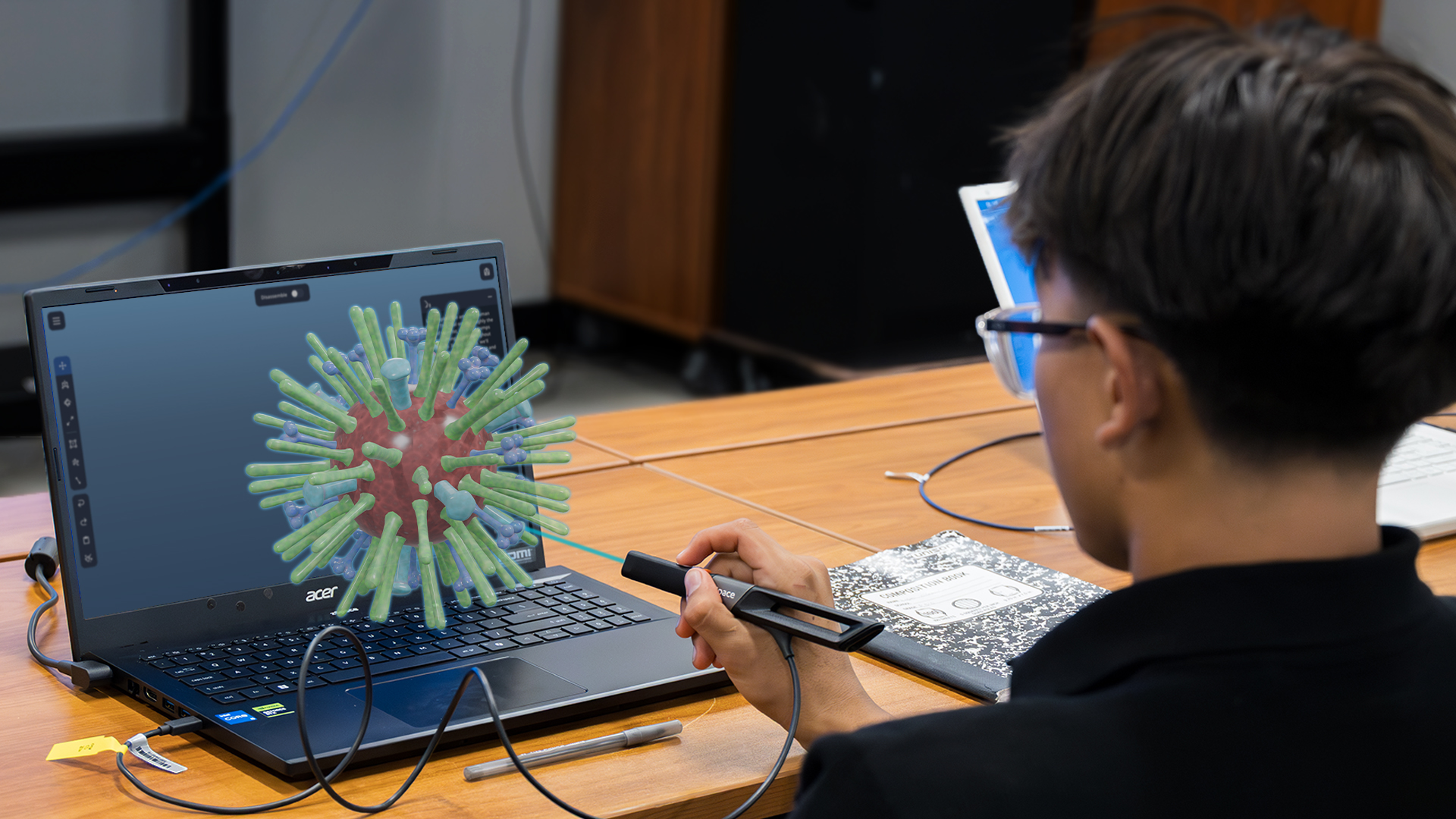
Stanford's body of research also highlights a second effect: immersive environments reduce the cognitive load of abstract topics. A student trying to mentally rotate a cell, a molecule, or a mechanical assembly in two dimensions is doing hard work that has nothing to do with the concept being taught. Put that same object on a zSpace laptop where they can rotate, dissect, and manipulate it with a stylus, and the cognitive budget frees up for actual learning.
Texas Tech University on Deeper Content Understanding
Research from Texas Tech University adds an important second finding: AR/VR does not just make content more engaging, it helps students understand it more deeply. Studies of immersive learning at Texas Tech and peer institutions consistently show that students who interact with three-dimensional, manipulable content develop stronger conceptual models of what they are studying, with better ability to transfer that knowledge to new problems.
This "deeper understanding" effect matters most in the subjects where student outcomes tend to stall: anatomy, physics, chemistry, earth science, and career and technical education topics like welding, electrical systems, and automotive diagnostics. These are domains where memorizing vocabulary is easy but truly understanding how the parts fit together is hard. Hands-on 3D interaction closes that gap.
Why Spatial Interaction Changes Learning
The mechanism is not mysterious. Humans evolved to learn by manipulating objects, not by reading about them. When a student can grab a heart, rotate it, peel back layers, and watch blood flow through the chambers, they build a mental model that a diagram on page 247 of a textbook cannot produce. AR/VR is not a gimmick layered over traditional teaching, it is a closer match to how the brain was designed to learn in the first place.
National Science Foundation Research on Hands-On Learning
The National Science Foundation has invested heavily in studying how active, hands-on learning affects student performance, especially in STEM. NSF-funded research has repeatedly found that students who engage in interactive, experiential learning experiences perform better on assessments than peers in lecture-dominated classrooms. This is the research backbone behind the broader national push toward inquiry-based and problem-based learning.
For many districts, though, "hands-on" is easier said than done. A well-equipped chemistry lab, a functioning human anatomy lab, a fully stocked CTE shop, a physics lab with frictionless tracks and motion sensors, these cost tens or hundreds of thousands of dollars per classroom and require consumables, safety protocols, and specialized teachers. Rural districts, Title I schools, and correctional education programs are routinely priced out of the very "hands-on" experiences the research says drive outcomes.
This is precisely the gap zSpace was built to close. Screen-based AR/VR brings virtual labs, dissections, simulations, and CTE training modules into any classroom at a fraction of the cost of physical equipment, without requiring constant internet connectivity or head-mounted displays. The hands-on learning the NSF research endorses becomes possible for every student, not just those in well-funded districts.
Real-World Results: Districts Using zSpace See Measurable Gains
Peer-reviewed research sets the foundation, but district outcomes tell the on-the-ground story. Schools that have adopted zSpace report concrete, measurable improvements in the metrics that matter most to superintendents and school boards.
At Teasley Middle School in Cherokee County School District, Georgia, educators piloted zSpace and then tracked performance against Georgia's College and Career Ready Performance Index (CCRPI). The results were significant: Teasley posted a 10-point gain on the CCRPI compared to the previous year, a jump meaningful enough that the district has since expanded zSpace to additional schools.
Similar patterns appear in other districts. California schools integrating zSpace virtual labs across science classrooms have reported double-digit percentage gains in standardized science test scores among students with consistent access to the platform. These gains are not the result of teaching to the test. They are the downstream effect of students who actually understand the material because they spent time inside it rather than only reading about it.
Why These Gains Are Reproducible
One reason these outcomes show up across very different districts is that zSpace is curriculum-aligned to national and state standards out of the box. Teachers do not have to choose between "the lesson we are supposed to teach" and "the cool VR thing." The standards-aligned content, combined with ready-to-use lesson plans and assessments, makes the platform a complement to the existing curriculum rather than an add-on competing for time.
How zSpace Turns Research Into Classroom Practice
The research above points to three conditions that drive AR VR student outcomes: strong engagement, deep conceptual understanding, and genuinely hands-on interaction. zSpace's product line is designed specifically to deliver all three in a way that works inside a normal school day and a normal school budget.
- Screen-based AR/VR eliminates the motion sickness, hygiene, supervision, and cost challenges of head-mounted displays, while still providing stereoscopic 3D and stylus-based interaction.
- Offline-capable software means classrooms in low-bandwidth, rural, or correctional environments get the same experience as well-connected suburban schools.
- Curriculum-aligned content libraries cover STEAM subjects and CTE pathways, with teacher resources built in.
- Versatile applications across anatomy, physics, chemistry, earth science, welding, electrical, automotive, and more mean one investment serves many teachers, not just one subject specialist.
Districts considering zSpace often ask about teacher adoption. The answer is encouraging: because the interaction is screen-based rather than headset-based, teachers can supervise the class visually, project student screens, and integrate zSpace activities into their existing lesson flow. Professional development and implementation support are built into every deployment, so the platform does not live or die based on a single tech-forward teacher.
Making an Evidence-Based Decision for Your District
If your district is weighing an AR/VR investment, the research should reframe the question. The question is no longer "does immersive learning work." Independent research from Stanford, Texas Tech, the National Science Foundation, and published peer-reviewed studies has answered that. The question is which AR/VR platform actually delivers the research-supported conditions inside real classrooms at a price the district can sustain.
A strong evaluation process includes a few steps:
- Review the research base. Ask vendors to point to specific peer-reviewed studies, not only marketing claims.
- Look at comparable districts. Ask for case studies from schools with similar demographics, budget, and technology infrastructure.
- Examine curriculum alignment. Confirm the platform maps to your state standards and to specific courses your teachers already teach.
- Pilot with outcome metrics in mind. Define success up front, whether that is assessment scores, course pass rates, engagement data, or CTE certification rates.
- Evaluate long-term support. Professional development, content updates, and technical support determine whether the platform still delivers three years after deployment.
For more on how education technology investments actually translate into outcomes, zSpace maintains an ongoing library of research-backed content, including key facts and figures on the impact of educational technology.
The Bottom Line on AR VR Student Outcomes
The effectiveness of immersive AR/VR learning is supported by a convergent set of evidence: Stanford research on engagement, Texas Tech findings on deeper conceptual understanding, National Science Foundation research on hands-on learning, and real district outcomes like the 10-point CCRPI gain at Teasley Middle School. Together, these sources answer the legitimate question administrators ask before investing in new technology.
zSpace was designed from the start to operationalize exactly the conditions this research identifies as drivers of student outcomes, and to do it in a way that works in rural, urban, Title I, CTE, and correctional education settings alike. The result is a platform that helps districts improve academic performance today while preparing students for careers in a technology-driven economy.
If you are ready to see what evidence-based AR/VR looks like in your district, schedule a demo with the zSpace team and we will walk you through the research, the outcomes, and a pilot plan tailored to your goals.