April 14, 2026
Hands-On, Purposeful Technology—Not More Screen Time
Director of Customer Success - Midwest/West
Not all screen time is equal. Learn why hands-on, purposeful learning technology replaces passive scrolling with active exploration for your child.
If you're a parent, you've probably had the thought: My child already spends too much time staring at a screen. Why would I want more technology in the classroom?
It's a fair question — and you're not alone in asking it. Across the country, families, school boards, and educators are having the same conversation about how much screen time is too much. But here's what that conversation often misses: not all screen time is the same. There's a meaningful difference between a child passively scrolling through videos and a child using hands-on, purposeful technology to dissect a virtual frog, build a working engine, or explore the surface of Mars.
That difference is exactly what zSpace was designed around. It's not another device that adds to the screen time problem. It's a learning tool that replaces passive watching with active doing — and the distinction matters more than most people realize.
The Real Problem Isn't Screens — It's Passive Consumption
When parents worry about screen time, they're usually picturing a very specific scenario: a child sitting alone, eyes glazed over, swiping or scrolling through content that demands nothing from them. That kind of passive consumption — watching videos, browsing social media, tapping through apps designed to hold attention rather than build skills — is what the research consistently flags as harmful.
And that concern is backed by science. In January 2026, the American Academy of Pediatrics updated its screen time guidelines, shifting away from strict hourly limits and instead emphasizing what children are doing on screens — the quality, the context, and whether the experience is interactive or passive. The message is clear: a child watching a video for thirty minutes and a child building a 3D model for thirty minutes are not having the same experience, even though both involve a screen.
Research from the Children and Screens Institute reinforces this point. Studies consistently show that active, interactive screen use — where children are creating, problem-solving, and making decisions — leads to better learning outcomes than passive viewing. The brain engages differently when a child is doing something versus simply watching something.
What Purposeful Technology Looks Like in a Classroom
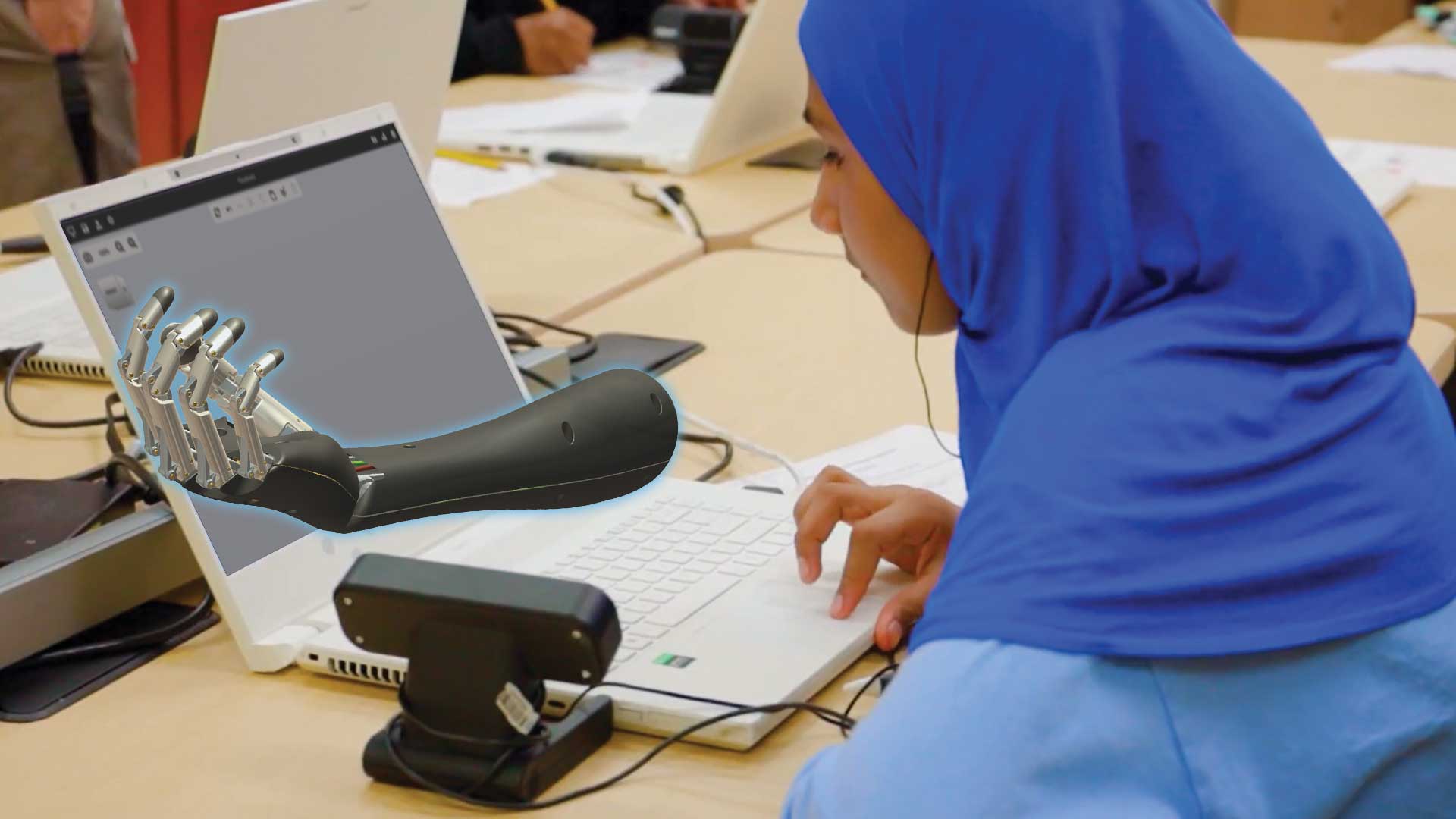
So what does active, hands-on technology actually look like in practice? Imagine your child sitting at a laptop-sized device in their classroom. But instead of reading a textbook on the screen or watching a teacher's slideshow, they're reaching out with a stylus — a pen-like tool — and physically interacting with a three-dimensional object that appears to float right in front of them.
They might be holding a beating human heart, rotating it to examine the chambers and valves from every angle. Or they could be disassembling a car engine piece by piece, learning how each component works together. In a chemistry lesson, they might be building molecules by snapping atoms together in 3D space and watching how different combinations create different compounds.
This is what zSpace brings to the classroom. It's a learning platform that combines a special screen with a stylus that lets students physically grab, move, rotate, and manipulate 3D objects — much like they would handle real materials in a science lab or workshop. The experience is closer to building with blocks or working with clay than it is to scrolling through a tablet.
A few things that make this different from typical screen time:
- It's physical. Students use their hands. The stylus provides tactile feedback, building the kind of muscle memory and spatial awareness that passive screens never can.
- It's collaborative. Students work together around the same device, discussing what they see, sharing the stylus, and solving problems as a team. It's the opposite of the isolating experience of a personal phone or tablet.
- It's tied to what they're learning. Every activity is connected to real curriculum standards — the same science, math, and career-readiness goals their teachers are already working toward. This isn't an entertainment app. It's a standards-aligned learning tool designed for the classroom.
Why Schools Across the Country Are Rethinking Technology
The conversation about screens in schools isn't theoretical anymore — it's driving real policy. In 2025 alone, 28 states enacted legislation restricting or banning personal phones in classrooms. States like New York, New Jersey, Florida, and Texas have all moved toward bell-to-bell device restrictions for the 2025–2026 school year. New Jersey even allocated $3 million in its 2026 budget to help schools implement phone-free policies.
This movement reflects something parents have felt for a long time: personal devices in classrooms are more often a source of distraction than learning. When students have access to social media, messaging, and entertainment apps during the school day, it's no surprise that focus and engagement suffer.
But here's what's important to understand: schools aren't moving away from technology. They're moving toward purposeful technology. The goal isn't to eliminate screens from education — it's to replace the distracting, passive kind with tools that actively help students learn. Educators and administrators recognize that technology itself isn't the problem. The problem is technology without purpose.
That shift is exactly where zSpace fits. While personal devices are being locked away because they encourage distraction, zSpace is being brought into classrooms because it does the opposite. It gives students something meaningful to do with their hands and minds. There's no social media, no notifications, no endless scroll — just focused, curriculum-driven learning experiences that teachers can trust and parents can feel good about.
What This Means for Your Child
As a parent, you want to know that the time your child spends in school is well spent — especially when technology is involved. Here's what purposeful, hands-on learning technology means in practical terms for your student:
Deeper understanding of complex subjects. Some concepts are genuinely hard to learn from a flat page or a two-dimensional diagram. Think about how your child might struggle to understand the chambers of the heart from a textbook illustration, or how a combustion engine actually works from a labeled diagram. Now imagine them picking up a 3D model of that heart, rotating it, peeling back the layers, and watching blood flow through each chamber in real time. Or taking apart a virtual engine piece by piece and putting it back together. When learning is that tangible, abstract ideas become concrete. Research consistently shows that this kind of interactive, multisensory experience improves both understanding and long-term retention.
Skills that translate beyond the classroom. When students use technology to create, build, and problem-solve rather than just consume content, they're developing the same skills that employers look for: critical thinking, spatial reasoning, collaboration, and technical confidence. Whether your child ends up in healthcare, engineering, trades, or any other field, the experience of working with their hands and minds together is preparation that matters.
Engagement you can actually see. Teachers and parents consistently notice the same thing: students want to work with this technology. When learning is active and tangible — when students can virtually dissect a specimen, build an architectural model, or explore the solar system in 3D — they're motivated in a way that traditional instruction and passive screens simply don't achieve. Students lean in instead of tuning out.
A learning experience designed for every kind of student. Not every child learns the same way. Some are visual learners, some learn best by listening, and many learn by doing. Because zSpace engages sight, sound, and touch simultaneously, it supports students across all learning styles — including those who have historically struggled in traditional classroom settings. The platform is designed to meet students where they are, not force them into a single mode of learning.
Asking the Right Question
The screen time conversation is important — and as a parent, your instinct to question it is the right one. But the most useful question isn't "How much screen time is my child getting?" It's "What is my child actually doing during that time?"
Are they passively watching? Or are they actively building, exploring, and creating? Are they isolated with a personal device? Or are they collaborating with classmates around a shared learning experience? Is the technology designed to hold their attention — or to develop their skills?
When the answers point to active, hands-on, curriculum-aligned experiences, you're looking at purposeful technology. And that's a very different thing from more screen time. It's the kind of technology that prepares students for what comes next — whether that's a career in healthcare, engineering, advanced manufacturing, or any field where thinking with your hands matters as much as thinking with your mind.
Schools that invest in purposeful technology aren't adding to the screen time problem. They're solving it — by giving students something worth doing, something that builds real skills, and something that parents, educators, and communities can stand behind together.
If you'd like to see what this looks like in action — and understand how it could be part of your child's classroom — learn more about the zSpace approach or request a demonstration at your school.