February 9, 2017
Heart Health Month: Interview with Dr. Desai
Executive Director of Customer Success
Interview with Dr. Desai reveals how 3D tech transforms heart education for kids during Heart Health Month. Learn more about this innovative program.
February is Heart Health Month, so this month the zSpace Team is sharing stories about the future of medicine. zSpace Director of Education Elizabeth Lytle, spent some time talking with Pediatric Cardiologist Dr. Kavin Desai to learn more about him and how he uses technology in his work as Medical Director of Camp Taylor.
Elizabeth: Can you tell us about what you do, and a little bit about your background?
Dr. Desai: I’m a pediatric cardiologist and I’ve been practicing now for 23 years! My primary role, of course, is as pediatric cardiologist - I do prenatal care and take care of infants, kids, and adults with heart disease. In the Cardiology world, I am what some refer to as an imaging specialist, so I work with ultrasound, MRIs, and CTs to visualize heart problems. Another of my roles is as Medical Director of a camp for kids with heart disease, which we started 14 years ago.
Elizabeth: What motivated you to start a camp for kids with heart disease?
Dr. Desai: The camp started with a premise of trying to help kids with heart disease and their families. Most kids with heart disease can’t go to regular camps because they’re too sick to go or the camps are too scared to take care of them. So we provide a fun, safe environment for them for them to get away from home and have a camp experience.
One thing that I felt is really important about heart camp is what we call Heart Education. Most of the kids that come to camp don’t really have a good understanding of what their heart problem is. They don’t understand their cardiac defects, why they occurred and what they mean for their future. At camp I found quickly that knowledge is incredibly powerful and Heart Education quickly became not only a critical part of camp but something that was important to constantly expand. The kids would go home after camp and do presentations about their heart disease to their classes, talk about it with their friends and begin to take more ownership of their personal care because of their deepened understanding. They became their own advocates.
Elizabeth: Talk a bit about the heart education program.
Dr. Desai: One of the things I do for every kid, and have done since the first camp, is to draw heart diagrams. Visualization is very powerful for kids - and for everybody, I think - as a tool not just to understand heart anatomy, but also to see how the parts of the heart work together.
And so I draw a diagram of a normal heart and a separate diagram of the individual child’s heart defect for every camper. Visualisation of their defects really give them an understanding of what their heart defect is and how it relates to the rest of the heart. It’s easier to show them that, well, because this valve isn’t working, here’s why the rest of your heart is having to work harder. It’s easy to see in a picture.
Elizabeth: A diagram for every camper - that’s a lot of work! A few years ago, the camp started a collaboration with zSpace. How did that collaboration start, and how is it changing your Heart Education program at camp?
Dr. Desai: I was at my daughter’s school, actually, and I think that’s the first time I ever saw zSpace. It was probably about 5 years ago and I was definitely thinking a lot about heart education and how empowering it is. And then I saw this new system and something clicked. I thought, “Gosh - wouldn’t it be amazing to actually have them visualize and understand the heart in 3 dimensions?” The heart, and human anatomy in general, is a 3-dimensional concept. What better way to understand a 3-dimensional structure than by seeing it in 3 dimensions. And that’s how the first collaboration started.
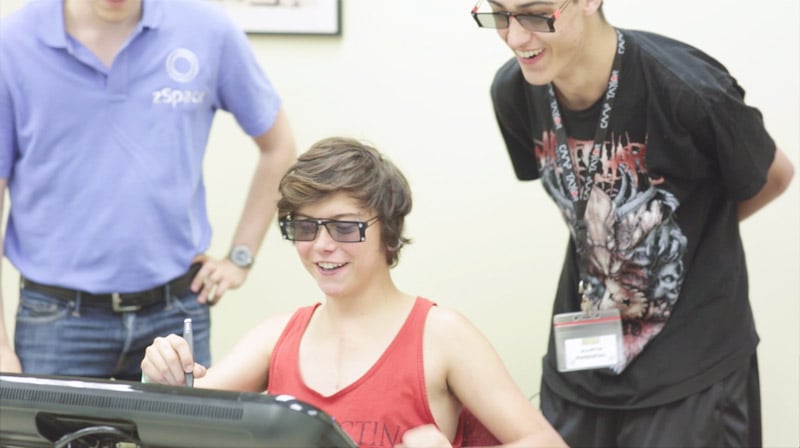
zSpace brought systems to camp and the kids just ate it up. Of course, tech is always a draw for kids, because they love techy things. But more importantly they were able to visualize how their hearts were put together and function, how the blood flowed, and also what their particular defect did to a normal heart’s function. So that’s how we started incorporating this 3D imaging modality into the education program at camp.
Elizabeth: This is all really interesting, and we can’t wait to learn more about your work! We’re out of time today, but we’ll be back soon with a video interview where we’ll talk with Dr. Desai about patient education and the future of AR and VR in medicine.
Want to learn more about Camp Taylor? Watch this video about how 3D imaging is used in the camp’s Heart Education program.