April 10, 2026
Maximize Perkins Funding for STEM to CTE Pathways
Director of CTE
Learn how to leverage Perkins V funds for zSpace AR/VR technology to bridge the gap between STEM and CTE without the high cost of consumable materials.
Federal Perkins V dollars represent one of the largest investments in career and technical education in the United States, but districts face a persistent challenge: how do you stretch those funds across dozens of career clusters while also building a true pathway from classroom science to workforce-ready skills? Perkins funding for CTE was designed to do exactly that—but getting maximum return on every dollar means selecting technology that serves STEM and CTE simultaneously, not in isolation.
zSpace AR/VR is purpose-built for this intersection. A single platform delivers standards-aligned STEM content for middle school learners and industry-aligned CTE training for high school students pursuing credentials in fields like welding, electrical, automotive, health sciences, and HVAC. That versatility is what makes it an exceptional Perkins V investment—and what allows districts to build a genuine STEM to CTE pathway rather than two disconnected programs.
Understanding the STEM-to-CTE Transition
The journey from a middle school science student to a high school graduate holding an industry-recognized credential is often fragmented. STEM education focuses on the "why"—the scientific, mathematical, and engineering principles that govern how the world works. CTE focuses on the "how"—the applied, hands-on skills that turn those principles into a trade, a career, or a credential. Too often, students experience these as two separate worlds with little connective tissue between them.
That gap is where students lose momentum. A student who is curious about circuits in an 8th-grade STEM class may never see how those same circuits power a panel in a high school electrical CTE course. A student who dissects a virtual heart in anatomy may never connect that skill to the suturing technique she practices in a health-sciences pathway. The content is related; the experience is not.
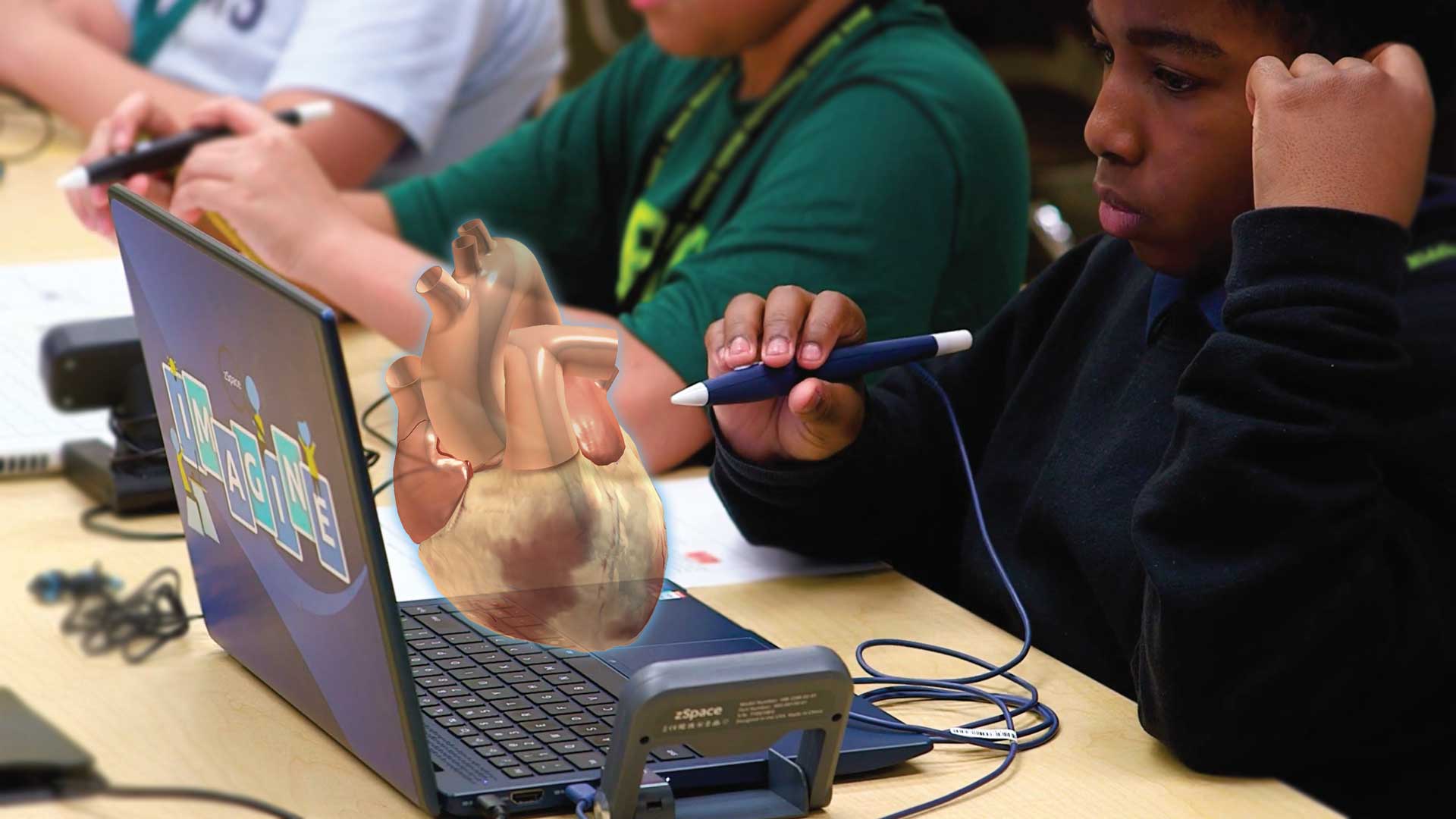
AR VR in technical education serves as the connective tissue between these two worlds. When students use zSpace, they manipulate the same 3D models across grade levels and subjects: exploring the cardiovascular system in STEM, then practicing a virtual procedure in CTE; visualizing hydraulic principles in physics, then operating a virtual excavator in construction. The platform, the stylus, and the models stay constant. The rigor deepens. The pathway becomes visible.
Bridging the STEM-to-CTE Pathway with zSpace
The federal Perkins V legislation specifically calls on districts to build programs of study—coherent sequences that link academic foundations to technical specialization. zSpace makes those sequences tangible. Here is how the pathway unfolds in a real zSpace district:
- Middle school STEM: Students explore the human cardiovascular system in 3D, rotating the heart in their hands, isolating chambers, and observing blood flow in context—not from a flat textbook diagram.
- High school health sciences CTE: The same students, now older, load zSpace health-sciences modules to practice virtual suturing, IV insertion, and patient assessment. The anatomy they already know becomes the foundation for the procedure they are now learning.
- Middle school STEM: Students build circuits in a physics unit, testing Ohm's Law with virtual resistors and power supplies.
- High school electrical CTE: Those same learners wire a virtual panel box, read schematics, and troubleshoot residential circuits—applying the principles they proved in STEM.
This is not a hypothetical. This is what an aligned STEM pathway feeding an aligned CTE program looks like when the underlying technology is consistent. For administrators, it also solves a practical Perkins V requirement: demonstrating that investments connect academic and technical learning rather than duplicating spending across silos.
How zSpace Creates Value from Perkins Funding
To qualify for Perkins funding for CTE, programs must demonstrate measurable effectiveness and alignment with workforce needs. zSpace meets both tests. A single zSpace platform supports dozens of industry pathways—automotive, welding, HVAC, health sciences, construction, manufacturing, and more—from the same device. That breadth satisfies the "scope" requirement of federal grants and makes every dollar work harder: one purchase, many pathways, multiple grade bands.
Even better, the same hardware driving CTE credential mastery in 11th grade is driving STEM exploration in 7th grade. Perkins V administrators who can point to a true K-12 pathway—not two separate purchases for two separate programs—are far better positioned in their local funding applications, and better aligned with the National Career Clusters Framework that anchors state CTE programs of study.
Hands-On Practice Without Consumable Costs
One of the heaviest burdens on CTE budgets is the cost of "consumables"—copper wire, welding rods, plastic tubing, medical supplies, and lab chemicals that are used once and discarded. These recurring costs quietly erode Perkins dollars year after year. zSpace fundamentally changes this equation by providing an environment for unlimited hands-on practice without consumable costs.
In a virtual environment, a student can practice a weld, a dissection, or a circuit wire-up a hundred times until they achieve mastery. There is no waste, no safety risk, and no additional cost for every repetition. This fail-safe environment allows students to build muscle memory and confidence before they ever step into a physical lab—and districts can redirect consumable savings toward new equipment, new pathways, or teacher professional development.
The Research: Measurable Gains from AR/VR Learning
The effectiveness of immersive technology in STEM and CTE classrooms is backed by rigorous, peer-reviewed research. Administrators justifying Perkins expenditures have concrete evidence to cite—not anecdotal impressions, but quantitative outcomes from controlled studies.
Measurable Test Score Gains
A 2022 peer-reviewed study on 3D, haptic-enabled virtual reality for teaching complex biological systems—specifically the human heart—found a 16% increase in test scores for students using zSpace compared to traditional learning methods. Students didn't just engage more; they retained more and performed better on standard assessments. That is the kind of data point that moves grant applications from "we hope this works" to "we know this works." The full study is cataloged in the zSpace Research Library.
Stronger 21st-Century Skills and Grit
A university-led research study by Dr. Rebecca Hite (Texas Tech University) and Andrew McIntosh (South Orangetown Central School District, NY) followed middle school students using zSpace for an engineering-design project. The findings, published in the book Cognitive and Affective Perspectives on Immersive Technology in Education, showed significant gains in the 4Cs—creativity, critical thinking, communication, and collaboration—along with observed improvements in grit, persistence, and resilience. These are the precise 21st-century skills CTE employers repeatedly rank as essential.
The researchers described zSpace as a platform that lets students "interact with STEM and CTE content in a flexible, user-driven environment." That is the explicit bridge Perkins V is asking districts to build. When soft skills and hard credentials grow from the same daily tool, the pathway from middle school science to a workforce-ready credential becomes the shortest possible line.
Conclusion
By leveraging Perkins funding for CTE to implement zSpace, districts can build a seamless STEM-to-CTE pathway backed by measurable learning gains, eliminate recurring consumable costs, and satisfy the federal requirement to connect academic and technical learning. The research is clear: AR/VR delivers double-digit test-score improvements and stronger 21st-century skills on a platform that spans middle school through workforce credentialing. Interested in seeing how a zSpace pathway could work in your district? Contact us today to schedule a demo, or explore our case studies from districts already making the transition.