May 27, 2026
STEAM Education: Why Arts Skills Drive STEM Careers
Vice President of Customer Success and Learning
Arts education builds the creative and design thinking skills that STEM careers increasingly demand. Explore why the A in STEAM matters.
When schools talk about preparing students for the future, the conversation almost always centers on coding, engineering, and data science. But increasingly, the most in-demand professionals in those same fields cite a different skill set as their competitive edge: the ability to think creatively, communicate visually, and approach problems with an artist's eye. STEAM education — adding Arts to the STEM framework — is not a compromise or a distraction from technical rigor. It is an acknowledgment that the most complex problems of our era require both kinds of intelligence.
From Silicon Valley design studios to biomedical research labs, employers are asking for workers who can do more than execute a technical task. They need people who can understand a user's experience, tell a compelling story with data, and imagine solutions that do not yet exist. These are skills developed in art class, theater rehearsal, and music theory — and they are becoming prerequisites for some of the fastest-growing STEM careers in the country.
This post explores why arts education is not a luxury add-on to STEM learning, but a foundational component of it — and how schools can build environments where both halves of the STEAM equation get the attention they deserve.
The Creative Skills Gap in STEM Workplaces
The demand for creative thinking in technical roles is not anecdotal. Research from Americans for the Arts consistently shows that employers across industries rank creativity, collaboration, and communication among their highest-priority hiring criteria — qualities developed through arts education as much as through technical training.[1] A landmark joint survey of U.S. business executives found that 72% cited creativity as a primary hiring concern — yet 85% of those same employers reported they could not find the creative applicants they were looking for.[1]
This gap has a name in workforce development circles: the STEAM skills deficit. Companies in technology, engineering, architecture, and healthcare report that candidates arrive technically competent but struggle with design thinking — the iterative, human-centered problem-solving approach that transforms a functional product into one people actually want to use.[2]
Design thinking is not a personality trait. It is a learned skill, and it is taught most naturally through arts education. Students who spend time in visual arts, drama, or creative writing learn to:
- Generate multiple solutions before committing to one
- Communicate complex ideas through visual and narrative means
- Receive and incorporate critical feedback without discarding the whole concept
- Tolerate ambiguity and work through problems without a single correct answer
These habits of mind are precisely what engineering teams, research labs, and technology companies describe when they say they want "creative problem-solvers." STEM-focused learning programs that integrate arts education give students a genuine advantage — not despite the arts component, but because of it.
What STEAM Careers Actually Look Like
One of the strongest arguments for arts integration in STEM education is the evidence sitting in job postings across the economy. The careers that sit at the intersection of technical and creative skill are among the fastest-growing and highest-paying in the workforce.
UX and Product Design
User experience design is one of the most sought-after roles in the technology sector. UX designers combine coding and data analysis with visual communication, empathy research, and storytelling. They prototype interfaces, conduct user interviews, and translate research findings into design decisions — a process that demands both analytical and artistic fluency. According to the U.S. Bureau of Labor Statistics, employment in web and digital interface design is projected to grow 7 percent from 2024 to 2034 — more than twice the average rate for all occupations.[3]
Data Visualization and Science Communication
As data sets grow larger and more complex, the ability to translate raw numbers into visual stories has become a specialized discipline. Data visualization specialists — who appear in newsrooms, public health agencies, financial institutions, and research universities — combine statistical literacy with graphic design and narrative judgment. A chart that obscures its findings is worse than no chart at all. The skill that makes the difference is artistic: knowing how to direct a viewer's attention and make meaning visible.
Architecture and Environmental Design
Architecture has always lived at the STEAM intersection, requiring structural engineering, materials science, geometry, and aesthetic vision in equal measure. But the field is expanding — sustainable building design, urban planning, and accessibility architecture all demand technical depth combined with the human-centered empathy that arts training cultivates.
Game Development and Simulation
Video game development and interactive simulation — including the educational software and AR experiences increasingly used in classrooms — require teams that span programming, 3D modeling, sound design, narrative writing, and character development. Career and technical education programs that include game design and digital media are preparing students directly for this industry.
What Arts Education Actually Teaches
The case for arts in STEAM education is sometimes framed defensively — as if arts advocates must prove that drawing class is secretly good for math scores. But the more direct argument is simpler: arts education develops a distinct and valuable set of cognitive skills that STEM disciplines do not fully address on their own.
Visual-spatial reasoning is developed through studio art, design, and 3D modeling. Students learn to translate a two-dimensional concept into three dimensions, read blueprints and diagrams, and manipulate objects mentally before building them physically. This is a core skill in engineering and architecture — and it is one that arts education builds directly.
Iterative thinking is the backbone of both artistic practice and modern product development. Artists sketch, revise, abandon, and restart as a matter of course. This comfort with iteration — with treating failure as information rather than defeat — maps directly onto engineering design cycles, scientific experimentation, and agile software development.
Multimodal communication is the ability to convey an idea not just through text or numbers, but through image, sound, movement, and narrative. Scientists who can visualize their research findings attract larger audiences and more funding. Engineers who can present a design concept persuasively to non-technical stakeholders move projects forward. These are arts skills with direct career value.
A comprehensive review of 62 arts education studies — Critical Links, compiled by Americans for the Arts — found that students with sustained arts education show higher engagement, stronger critical thinking scores, and greater persistence — outcomes that benefit STEM learning as much as any other subject.[4]
Bringing Arts Into STEM Classrooms
For many educators, the challenge is not philosophical — it is logistical. STEM-focused schools and programs often operate under significant curriculum pressure, and finding space for arts integration requires intentionality and the right tools.
Effective STEAM integration does not mean adding a separate art class to a STEM schedule. It means finding the creative dimension already present in technical subjects and making it explicit:
- In biology: students diagram cell structures, build 3D models of organisms, and create visual narratives of biological processes.
- In physics: students design experiments, sketch force diagrams, and present findings with data visualizations they create themselves.
- In engineering: students iterate through design cycles that include aesthetic judgment alongside structural analysis.
- In computer science: students design user interfaces, develop visual logic for game mechanics, and communicate algorithmic thinking through flowcharts and diagrams.
Teacher support is critical here. Educators who are confident in STEM content but less experienced with arts integration benefit from curriculum resources that bridge both domains — lesson frameworks, exemplar projects, and professional development that helps them see where the creative dimensions of their subject already exist. STEM.org and similar organizations have developed accreditation frameworks that include arts integration as a marker of quality STEM programming.[5]
How zSpace Supports Integrated STEAM Learning
One of the structural barriers to STEAM integration is the cost and complexity of providing hands-on experiences across both technical and creative domains. A school that wants students to design and build — to move through the full STEAM cycle of ideation, modeling, testing, and refinement — traditionally needed separate resources for each phase.
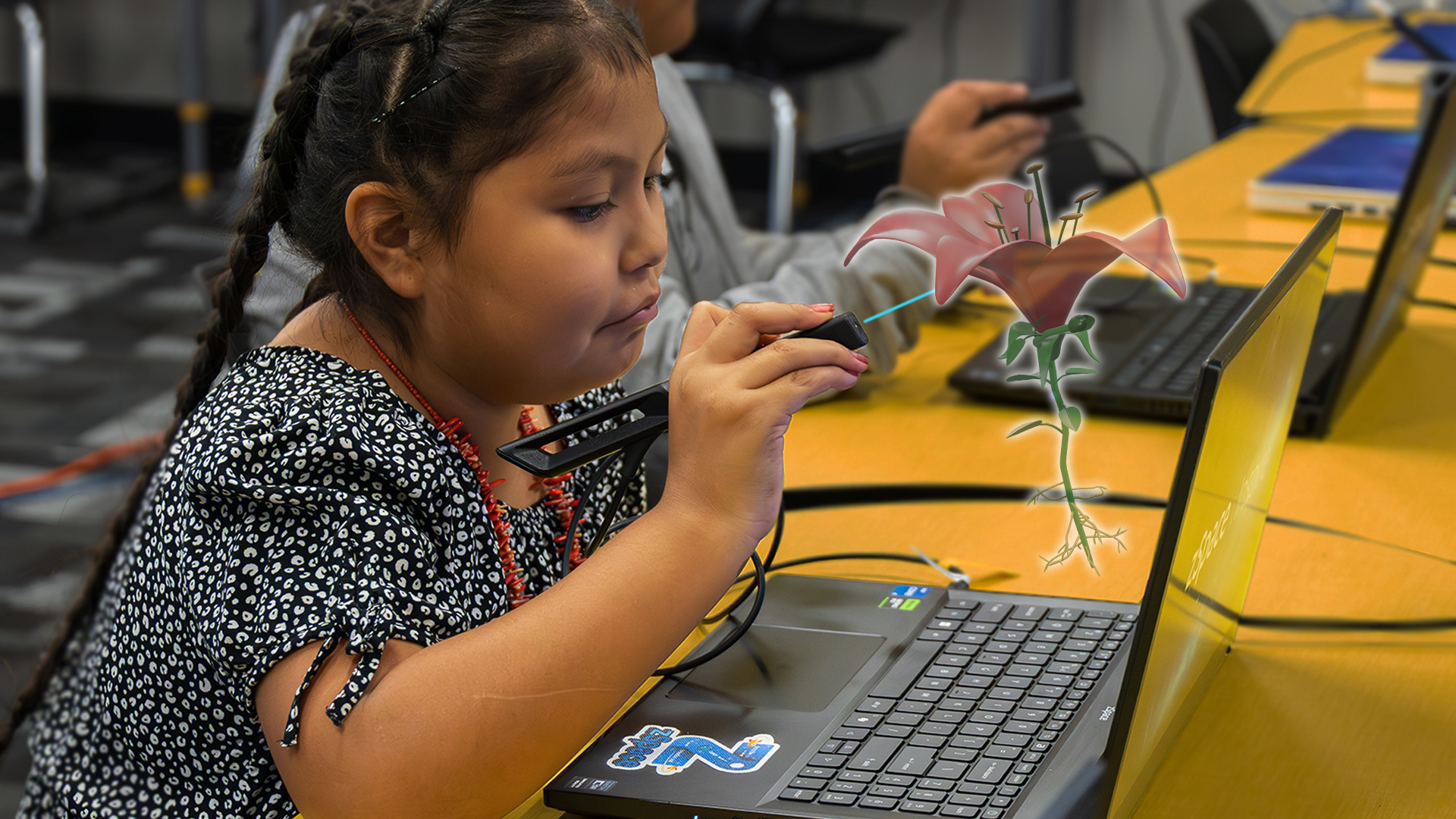
zSpace addresses this directly. The zSpace platform uses screen-based augmented reality to let students interact with three-dimensional models across subjects — examining the internal structure of a human heart, dissecting geological formations, or building and testing mechanical systems — all without head-mounted displays or specialized lab setups. This same immersive environment supports the creative and visual reasoning skills that STEAM education emphasizes.
Students using zSpace can:
- Explore the geometry and structure of real-world objects from multiple angles, building the visual-spatial skills that arts and engineering share
- Move through iterative design processes in a low-stakes virtual environment, revising and experimenting without consuming physical materials
- Engage with curriculum-aligned content that spans STEM subjects and creative applications — from virtual dissections to architectural modeling
For schools in rural areas or with limited budgets, zSpace's offline capability means that immersive STEAM learning is accessible without reliable broadband — removing one of the most persistent barriers to technology-enhanced instruction. And for teachers navigating the challenge of arts integration without deep personal expertise in both domains, zSpace's curriculum resources and teacher support tools provide a scaffold for building connected, cross-disciplinary lessons.
Explore the full range of zSpace applications to see how the platform supports integrated learning across subjects.
Building the Next Generation of STEAM Professionals
The question of whether the "A" belongs in STEAM has largely been settled by the job market. The most in-demand technical roles require creative fluency. The most innovative companies hire for both. And the students who arrive at college and early careers with strong arts backgrounds alongside their STEM preparation are increasingly the ones who stand out.
For educators, the practical implication is straightforward: arts integration is not a curricular luxury. It is a workforce preparation strategy. Students who learn to think visually, communicate creatively, and approach problems iteratively are better prepared for the full spectrum of STEAM careers — from biomedical engineering to game design to data science to architecture.
Building that foundation requires curriculum alignment, the right tools, and teacher support — exactly what a well-resourced STEAM education program provides. Schools that invest in the full STEAM model are not hedging against STEM. They are deepening it.
Ready to bring integrated STEAM learning to your school? Connect with the zSpace team to learn how AR-powered immersive experiences can support both technical and creative learning across your curriculum.
References
- The Conference Board, Americans for the Arts, and American Association of School Administrators. Ready to Innovate: Are Educators and Executives Aligned on the Creative Readiness of the U.S. Workforce? October 2008. americansforthearts.org
- Hasso Plattner Institute of Design at Stanford (d.school). Design Thinking Bootleg. Stanford University. dschool.stanford.edu; see also IDEO, ideo.com.
- U.S. Bureau of Labor Statistics. "Web Developers and Digital Designers." Occupational Outlook Handbook. U.S. Department of Labor, 2024. bls.gov
- Deasy, Richard J., ed. Critical Links: Learning in the Arts and Student Academic and Social Development. Americans for the Arts, 2002. americansforthearts.org
- State Education Agency Directors of Arts Education (SEADAE). STEAM and the Role of the Arts in STEM. National Art Education Association, 2020. nationalartsstandards.org