November 9, 2026
How VR Expands Healthcare Training Without More Clinics
VR is helping healthcare programs train more nurses and allied health workers by expanding clinical capacity and reaching underserved areas.
The United States faces a healthcare workforce shortage that traditional education models cannot solve alone. The American Hospital Association projects a shortfall of up to 3.2 million healthcare workers by 2026, driven by an aging population, accelerating retirements, and training programs that cannot expand fast enough to meet demand. VR healthcare training is giving programs a practical way to scale capacity without the clinical site bottleneck that has constrained nursing and allied health education for decades.
The shortage is not evenly distributed. Rural communities, underserved urban areas, and regions with fewer teaching hospitals face the steepest gaps between the healthcare workers they need and the training infrastructure available to produce them. Programs in these areas often have qualified applicants they cannot admit because they lack enough clinical placement sites, simulation lab seats, or specialized instructors to train them.
Virtual reality offers a way to break through these constraints. By creating immersive clinical environments that students can access on campus, on flexible schedules, and without competing for scarce patient encounters, VR supplements traditional training in ways that expand both the quantity and quality of healthcare education.
The Clinical Placement Bottleneck
The single biggest constraint on healthcare training capacity is clinical placements. Nursing programs, allied health programs, and medical schools all require students to complete supervised hours in real clinical settings. These placements depend on partnerships with hospitals, clinics, and healthcare systems that have limited capacity to host students alongside their patient care responsibilities.
The math is straightforward: every clinical site can accommodate only a fixed number of students per rotation. When demand for healthcare workers rises, programs cannot simply admit more students because the clinical sites are already full. Qualified applicants get wait-listed or turned away entirely. The Bureau of Labor Statistics projects registered nursing alone will need more than 175,000 new nurses per year through 2032, a pace that current training capacity cannot sustain without structural changes to how clinical education is delivered.
VR does not replace clinical placements. It supplements them. By shifting a portion of early-stage clinical skill development into immersive simulations, programs free up clinical site capacity for the advanced, patient-facing experiences that require real healthcare settings. The California Board of Registered Nursing now permits up to 50% of clinical hours to be completed via simulation, a policy change that reflects growing evidence that well-designed simulation produces learning outcomes comparable to traditional clinical rotations.
How VR Expands Healthcare Training Capacity
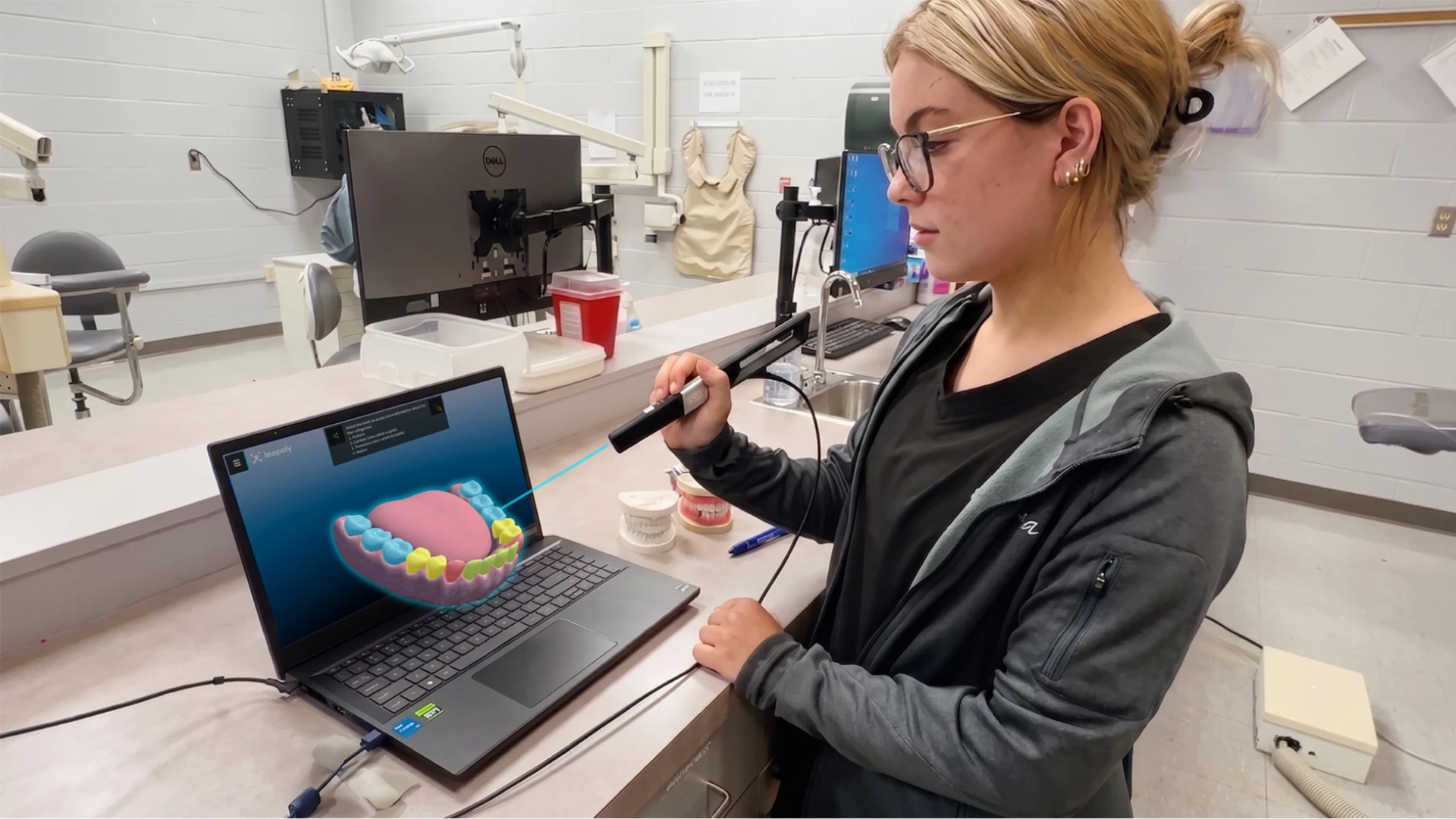
zSpace's screen-based AR/VR platform delivers immersive 3D visualization and interaction through a display and stylus, without the isolating headsets that create hygiene and supervision challenges in shared educational settings. Students manipulate anatomical models, practice diagnostic procedures, and work through patient scenarios while remaining fully present in the classroom. Instructors can observe, coach, and facilitate discussion in real time.
More Students Per Program
VR simulation stations require less physical space than traditional simulation labs and can serve students on flexible schedules. Programs that integrate VR into their curriculum sequence can admit more students per cohort because the early clinical hours that previously required scarce placement sites now happen on campus. This is particularly impactful for community college nursing programs, which train a large share of the nursing workforce and face the tightest clinical capacity constraints.
Extended and Flexible Practice Hours
Traditional clinical rotations happen on fixed schedules dictated by hospital availability. VR labs can operate during evenings, weekends, and outside standard academic terms. Programs that offer extended VR lab access report significant improvements in completion rates among part-time and working students who struggle to fit rigid clinical schedules around jobs and family responsibilities.
Broader Exposure to Clinical Scenarios
In traditional rotations, the patient cases a student encounters depend entirely on who happens to be in the hospital during their scheduled hours. A student might complete an entire clinical rotation without seeing a cardiac emergency, a rare condition, or a complex medication interaction. VR eliminates this variability. Programs can ensure every student encounters a standardized set of scenarios that covers the full range of conditions and procedures required for competent practice.
Quality Improvements Through Standardized Training
Expanding capacity matters only if training quality keeps pace. VR delivers several quality advantages that traditional clinical education struggles to match.
Consistent Learning Experiences
Two students in the same program can have vastly different clinical experiences depending on their rotation site, preceptor, and patient mix. This variability means graduates leave with uneven skill sets. VR standardizes the baseline. Every student completes the same core scenarios, practices the same procedures, and meets the same performance benchmarks before advancing. Employers report greater confidence in the consistent skill levels of graduates from programs that incorporate standardized simulation.
Unlimited Repetition Without Risk
Healthcare procedures require precision that develops through repetition. In clinical settings, students may perform a procedure once or twice before moving to the next rotation. VR lets students repeat procedures as many times as needed until they achieve mastery. A nursing student can practice IV insertion, medication administration, or patient assessment dozens of times in a single session. This concentrated practice builds the muscle memory and procedural confidence that translate directly to better performance in real patient care.
Visualization of Internal Anatomy and Physiology
Understanding three-dimensional anatomical relationships is foundational to nearly every healthcare discipline. Textbook illustrations and even cadaver labs provide limited perspectives. VR lets students explore anatomical structures from any angle, layer by layer, with the ability to isolate systems, observe physiological processes in motion, and see spatial relationships that are impossible to appreciate from static images. This deeper spatial understanding improves diagnostic reasoning and procedural accuracy across disciplines from nursing to medical laboratory science to dental hygiene.
Reaching Underserved Communities
The healthcare workforce shortage hits hardest in communities that can least afford it. Rural areas, tribal communities, and underserved urban neighborhoods face acute provider shortages compounded by limited access to healthcare education. Building new simulation labs or establishing clinical partnerships in these regions requires capital investment and institutional relationships that take years to develop.
VR technology compresses that timeline. A community college in a rural area can deploy VR workstations that provide access to the same immersive training scenarios available at major urban teaching hospitals. The technology works offline, which matters in regions where internet connectivity is unreliable. Students in these programs can build clinical competency locally rather than relocating to urban centers for training, which increases the likelihood that they will practice in their home communities after graduation.
This geographic accessibility is one of VR's most significant contributions to addressing healthcare workforce distribution. Training more workers is necessary, but training them in the communities where they are needed most is what actually closes the gap in patient access.
Applications Across Healthcare Disciplines
Nursing Education
Nursing programs face the most acute capacity constraints and stand to benefit the most from VR integration. Virtual clinical rotations let students experience consistent scenarios across medical-surgical, pediatric, and emergency specialties. High-risk situations like code responses and medication errors can be practiced repeatedly in a consequence-free environment. Programs integrating comprehensive VR training report both expanded enrollment capacity and improved performance on professional certification examinations.
Allied Health Professions
Respiratory therapy, medical laboratory science, radiologic technology, and other allied health programs share the same clinical placement constraints that limit nursing. VR simulations give these programs additional training capacity while exposing students to equipment and procedures they may not encounter frequently enough during traditional rotations. The breadth of zSpace healthcare applications covers multiple allied health disciplines from a single platform.
Implementation for Healthcare Education Programs
Healthcare programs integrating VR successfully share several implementation patterns.
Curriculum sequencing. VR is most effective when positioned before traditional clinical rotations in the curriculum sequence. Students build foundational skills and spatial understanding in simulation, then apply and refine those skills in real patient care settings. This sequence reduces the supervision intensity required during early clinical experiences.
Faculty buy-in through evidence. Healthcare faculty can be skeptical of technology replacing patient contact. Framing VR as a supplement that expands capacity rather than a replacement for clinical experience, backed by the growing body of evidence on simulation effectiveness, builds faculty support. Programs that invest in faculty development around simulation pedagogy see the highest adoption rates and strongest outcomes.
Accreditation alignment. State boards of nursing and allied health accrediting bodies have increasingly recognized simulation hours toward clinical requirements. Programs should work with their accreditors to understand how VR simulation maps to clinical hour requirements, ensuring that the capacity expansion VR enables is fully recognized in their accreditation framework.
Funding pathways. CTE programs at community colleges can leverage Perkins V funding for VR technology aligned with healthcare career pathways. Health Resources and Services Administration (HRSA) grants specifically target nursing workforce expansion and may support simulation technology investments. Industry partnerships with healthcare systems that benefit from a stronger graduate pipeline represent another funding avenue.
Meeting the Healthcare Workforce Challenge
The healthcare workforce shortage is not a problem that will resolve on its own. Demand for care will continue to grow as the population ages, and the structural constraints on clinical training capacity will persist unless programs adopt new approaches to how they educate healthcare workers.
VR does not replace the irreplaceable: real patient interaction, clinical judgment developed through experience, and the mentorship relationships that shape healthcare professionals. What it does is remove the bottleneck that prevents programs from training enough workers to meet the need. By expanding clinical capacity, standardizing training quality, extending access to underserved communities, and enabling the concentrated practice that builds confident practitioners, VR gives healthcare education the scalability it has lacked.
To explore how zSpace VR solutions can expand your healthcare training programs, review case studies from education providers or connect with our team.