November 16, 2026
VR Training: Closing the Skills Gap in Critical Industries
Millions of skilled jobs sit unfilled across the U.S. VR training helps produce job-ready workers faster in manufacturing, healthcare, and the trades.
The United States is short millions of skilled workers, and the gap is widening. The Manufacturing Institute projects 2.1 million manufacturing jobs could go unfilled by 2030, costing the economy up to $1 trillion in lost output. Healthcare faces a shortage of 3.2 million workers by 2026. Automotive and energy sectors report similar shortfalls. VR training is emerging as one of the most effective ways to close the skills gap across these critical industries.
The problem is not a lack of willing workers. It is a mismatch between how quickly industries evolve and how slowly traditional training programs can respond. Employers need technicians who can operate advanced CNC equipment, nurses who can handle complex patient scenarios, and automotive specialists who understand hybrid and electric vehicle systems. Conventional training methods struggle to produce these workers fast enough, at scale, and at a cost that institutions can sustain.
Virtual reality addresses that mismatch directly. By creating immersive, repeatable training environments that simulate real workplace conditions, VR compresses the time from enrollment to job-readiness while reducing the cost of delivering hands-on instruction. For employers and educators facing urgent workforce demands, it represents a practical shift in how skilled workers are developed.
Why Traditional Training Cannot Keep Pace
The skills gap is not simply a volume problem. It reflects structural limitations in how workforce training has been delivered for decades.
Safety constraints limit practice time. In high-risk fields like welding, electrical work, and surgical procedures, beginners cannot safely practice on real equipment or patients until they reach a baseline level of competence. Building that baseline through observation and classroom instruction alone is slow and often insufficient.
Equipment access creates bottlenecks. Advanced manufacturing equipment, diagnostic systems, and clinical simulation labs cost hundreds of thousands of dollars. Training programs cannot take production-grade machinery offline for student use, and few institutions can afford duplicate equipment dedicated solely to instruction. The result is limited lab seats and long wait lists.
Apprenticeship models do not scale. One-on-one mentorship produces highly skilled workers, but it cannot generate the volume of graduates that industries need. Experienced technicians pulled into training roles reduce productive capacity on the shop floor, and the mentors themselves are in short supply as retirements accelerate.
Curriculum lags behind technology. By the time a training program updates its equipment and coursework to reflect current industry practices, the industry has moved on. Graduates trained on last-generation systems require additional on-the-job training before they can contribute productively.
How VR Training Closes the Gap
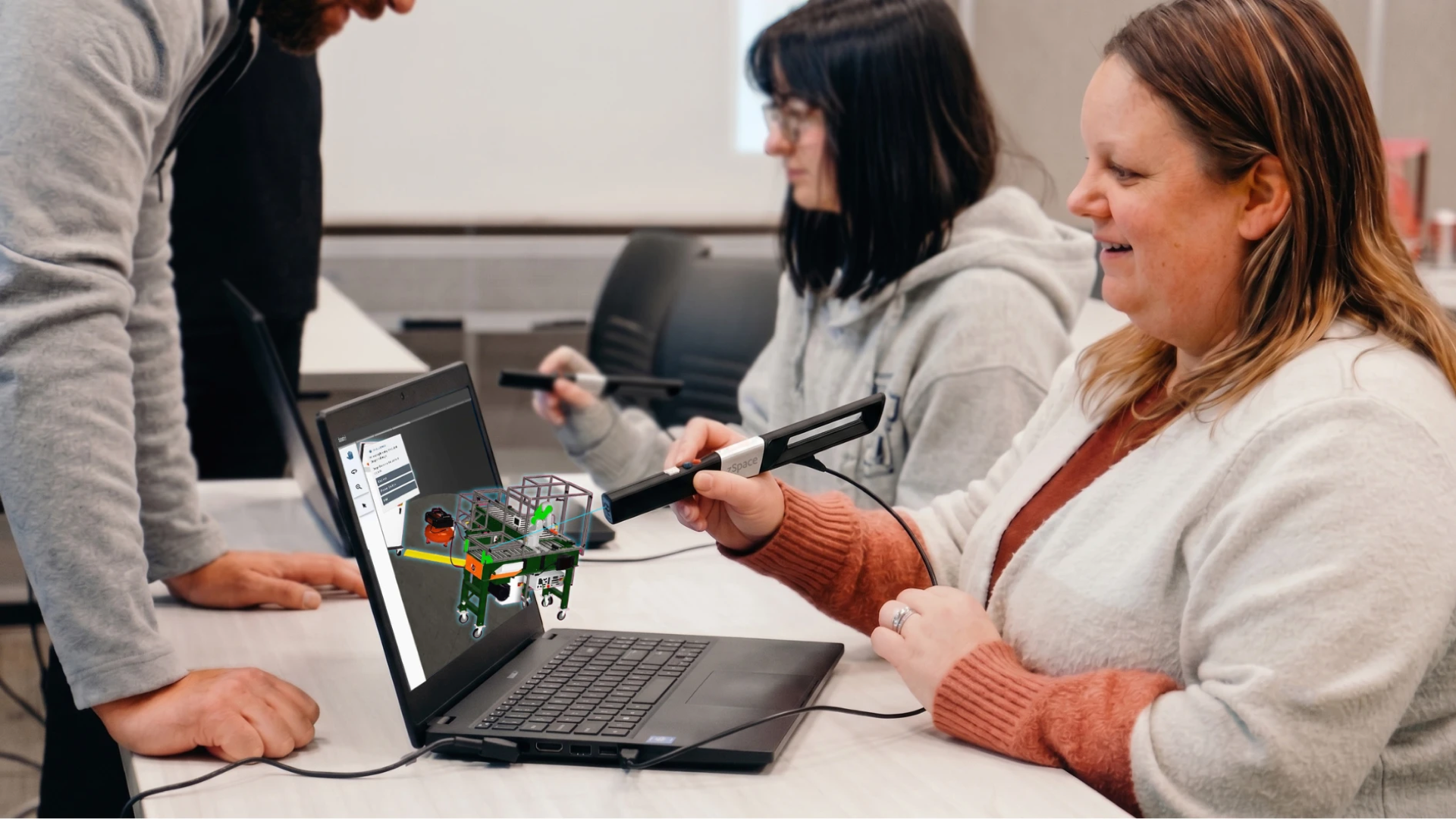
Virtual reality eliminates several of these constraints simultaneously. zSpace's screen-based AR/VR platform delivers immersive 3D simulations where learners interact with realistic virtual equipment using a stylus interface. Unlike headset-based VR, this approach keeps students connected to their instructors and classmates, works offline in facilities with limited internet, and avoids the hygiene and supervision challenges that headsets introduce in shared training environments.
The practical impact on workforce development is significant across several dimensions.
Faster Time to Competency
VR lets learners practice procedures repeatedly in a risk-free environment before ever touching physical equipment. A welding student can run dozens of virtual passes to develop proper technique, travel speed, and hand position. A nursing student can perform patient assessments across a wide range of scenarios in a single session. This concentrated practice compresses the learning curve in ways that traditional instruction, limited by equipment availability and safety concerns, simply cannot match.
Research on immersive learning consistently shows that VR-trained students develop spatial understanding and procedural skills faster than those trained through conventional methods. When these students transition to hands-on work, they arrive with stronger foundations and make fewer early errors.
Lower Training Costs at Scale
The economics of VR training improve as programs scale. A single VR workstation replaces consumable materials in welding, machining, and medical training. It eliminates the wear and tear on expensive physical equipment used for instruction. It reduces the facility footprint required to train each student, since virtual lab stations take less space than full equipment setups.
For industries investing in their own training programs, VR also reduces the cost of pulling experienced workers off production lines to serve as instructors. Simulations handle the repetitive practice that consumes the most instructor time, freeing human experts to focus on advanced coaching and assessment where their expertise has the greatest impact.
Scalable Access to Diverse Training Scenarios
Physical training environments can only expose learners to the equipment and scenarios that are physically present. A community college automotive program may have access to three or four vehicle models. A nursing program depends on whatever patient cases happen to present during clinical rotations.
VR removes these limitations. zSpace applications span manufacturing, healthcare, automotive, and dozens of other technical fields. A single platform gives learners access to equipment configurations, diagnostic scenarios, and procedural variations that would require millions of dollars in physical resources to replicate. This breadth of exposure produces workers who are more adaptable when they encounter unfamiliar situations on the job.
VR Training Across Critical Industries
Manufacturing
Manufacturing faces the largest absolute skills shortage, driven by retirements, automation adoption, and the increasing sophistication of production equipment. VR training addresses this by letting students practice CNC setup, robotic system operation, quality inspection, and safety protocols on virtual equipment that accurately represents current industrial systems. Programs using VR-integrated curricula report that students require less ramp-up time when they enter actual production environments, which directly addresses employers' most pressing concern: time from hire to productive contribution.
Healthcare
The healthcare workforce shortage is compounded by severe constraints on clinical training capacity. Nursing programs turn away thousands of qualified applicants annually because clinical placement sites are scarce. VR simulations expand training capacity by supplementing clinical hours with immersive patient scenarios. Students practice anatomy visualization, diagnostic procedures, and patient assessment in environments where they can repeat complex scenarios until they achieve mastery, something impossible in traditional clinical rotations where each patient encounter happens once.
Automotive Technology
Modern vehicles incorporate advanced electronics, sensor arrays, and electric drivetrains that differ fundamentally from the mechanical systems technicians were traditionally trained on. VR automotive applications let students visualize and interact with these complex systems in three dimensions, exploring fault conditions and diagnostic workflows that would be dangerous or impractical to reproduce in a physical training bay. The result is technicians who arrive at dealerships and repair shops with diagnostic skills matched to current vehicle technology rather than systems that were current five years ago.
The Employer Perspective: Training ROI
For employers evaluating VR training investments, the return shows up in several measurable areas.
Reduced onboarding time. New hires trained with VR arrive with stronger baseline skills. They spend less time in orientation and supervised practice before contributing productively. For manufacturers and healthcare systems operating at capacity, even a few weeks of accelerated onboarding per employee adds up to significant operational value.
Lower error rates. Workers who have practiced procedures extensively in simulation make fewer costly mistakes during their first months on the job. In manufacturing, this means less scrap material and equipment damage. In healthcare, it translates to better patient safety outcomes.
Improved retention. Employees who feel prepared and confident in their roles are more likely to stay. High turnover in skilled positions is expensive, both in direct replacement costs and in lost productivity during the transition. Training programs that build genuine competence before workers face the pressures of production contribute to retention.
Scalable partnerships with education. Employers who invest in VR technology at partner colleges and training programs create a more reliable talent pipeline. The training aligns with actual workplace requirements because the simulations can be configured to match the specific equipment and processes in use at the employer's facilities.
Funding and Implementation
The cost of VR training technology has decreased steadily while capabilities have expanded, making it accessible to a broader range of institutions and employers. Several funding mechanisms support adoption.
Perkins V funding supports technology investments in career and technical education programs. Workforce innovation grants from the Department of Labor target training approaches that demonstrate measurable improvement in employment outcomes. Industry-sponsored partnerships allow employers to co-invest in training infrastructure at community college CTE programs that feed their hiring pipeline.
Successful implementations follow a consistent pattern: start with the disciplines where consumable costs or equipment constraints create the biggest bottleneck, integrate VR into the existing curriculum sequence rather than treating it as a standalone add-on, and invest in faculty development so instructors can facilitate learning effectively in the immersive environment.
Closing the Gap Requires New Approaches
The skills gap across manufacturing, healthcare, and automotive technology is not a temporary disruption. It reflects a permanent shift in how fast industries evolve relative to how fast traditional training can produce qualified workers. Addressing it requires training methods that are faster, more scalable, and less dependent on physical resources that are expensive and inherently limited.
VR training meets those requirements. It compresses time to competency, reduces per-student training costs, scales access to diverse scenarios, and produces workers who perform better in their first months on the job. For employers and educators who cannot afford to wait for the skills gap to resolve itself, it offers a proven path forward.
To see how zSpace VR solutions are helping organizations close the skills gap, explore case studies or connect with our team.